
Cavity wall insulation
 Completed within one day
Suitable for homes with cavity walls
Greater living comfort
Average savings of 15–30% on energy bills
Relatively low investment with a quick payback period (3-5 years)
>30,000 cavity wall insulation projects completed since 1959
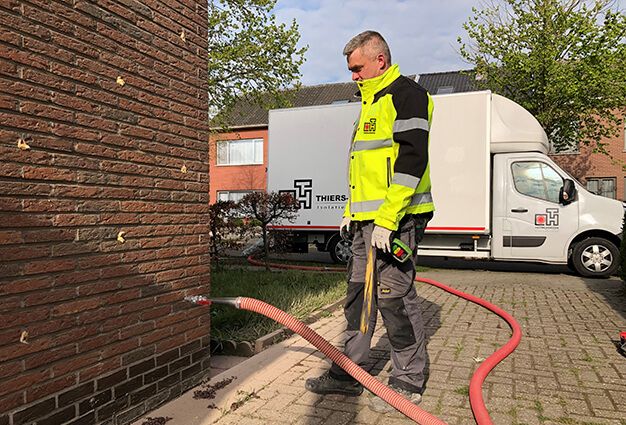
Does my house have cavity walls?
Homes built in the 1960s and 1970s often have cavity walls:
Inner cavity wall (quick-build): 14 cm
Air cavity: 5–7 cm
Outer cavity wall (facing brick): 8–10 cm
Homes built before 1950 are more likely to have solid walls than cavity walls.
Homes built after 1980 often have insulation and cavity walls.
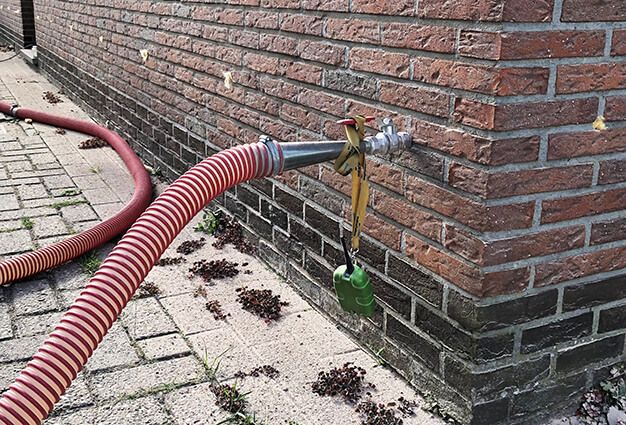
What is cavity wall insulation?
Cavity wall insulation means that the open (air) space between the two parts of an exterior wall of a house is insulated.
This means that much less heat is lost through the walls.
Homes built before 1990 are particularly suitable for this and immediately benefit from lower energy consumption and greater living comfort.

Quality assurance
Qualified inspectors
- 3-yearly refresher training
- Within BCCA quality framework for retrofitting insulation
Certified contractors
- Qualified professionals
- URSA trained
ATG Inspection
- Implementation in accordance with STS71-1
- Regular monitoring/follow-up BCCA
Advantages of cavity walls
Save energy and reduce heating costs
Approximately 30% less heat loss through the walls reduces your energy bill.
Comfort and quality of life
More pleasant indoor temperature and less cold and draughts
Increase in value upon sale of property
More energy-efficient homes are more attractive on the housing market due to improved EPC scores
Sustainability and lower CO2 emissions
Reducing energy consumption lowers your home’s carbon footprint.
With mineral wool (URSA)
- Good thermal insulation
- Good sound insulation
- Sustainable
- Non-flammable
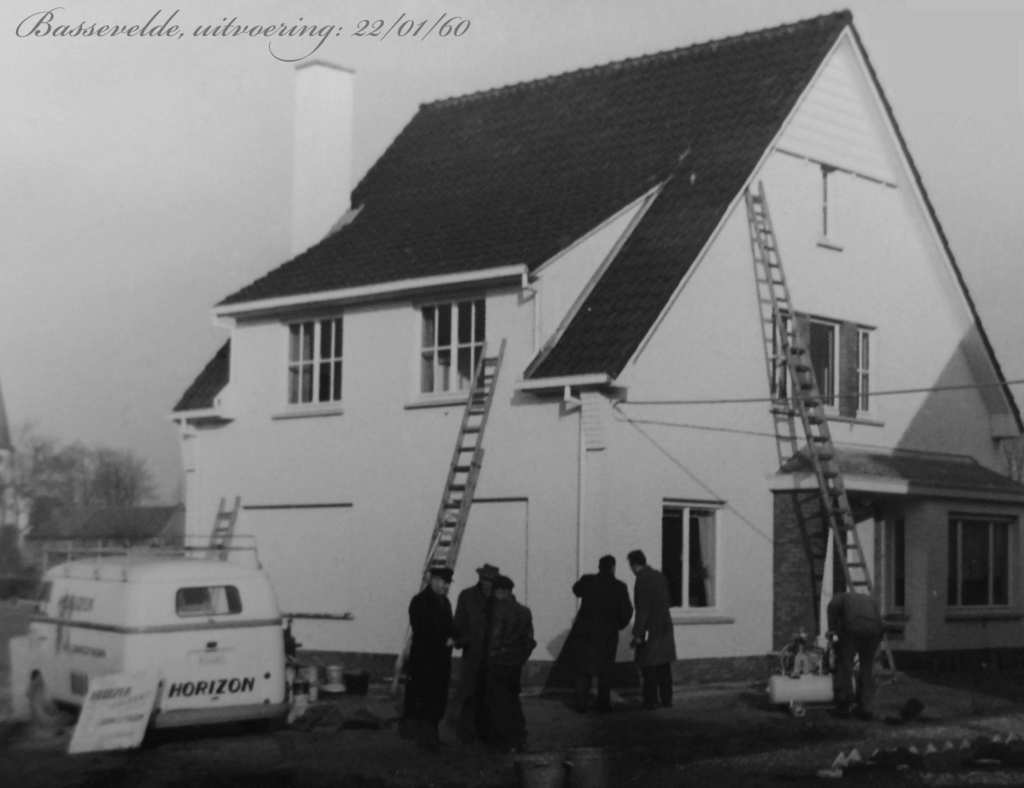
‘The year Thiers-Horizon was founded also saw the completion of the first homes with cavity wall insulation!’
FAQ
Premium
From March 2026, there will be new subsidies for cavity wall insulation, depending on your income category:
- Lowest income category 4: 50% premium on your invoice
- Lowest income category 3: 35% premium on your invoice
- Middle income category 2: not eligible for premium
- Middle income category 1: not eligible for premium
More information and conditions can be found at: My Renovation Grant |
Painted façade
Preferably, exterior walls should be painted with vapour-permeable paint.
However, many homes were treated with vapour-proof paint a long time ago.
Since 1959, we have also been insulating painted walls without any problems. Damage can only occur in the case of existing moisture problems, because the facing brick cannot dry out towards the inside (peeling paint or cracking bricks).
Our inspector always checks in advance whether cavity wall insulation is safe.
Cost per square metre
The average cost is between €20 and €30 per square metre (including VAT).
The final price depends on factors such as the surface area, the width of the cavity and the nature of the work.
Puin in gevel
If there is debris in the cavity, insulation cannot be installed.
The debris must first be removed, after which the cavity can be refilled.
Refilling cavity walls
If your home already has insulation but there is still an air cavity of at least 3 cm, we can add extra insulation to the walls for even better results.
(No premium)
Thin cavity wall
Is the cavity between the walls smaller than 5 cm but larger than 3 cm? Then insulation can still be installed, after inspection, of course.
(No premium)
Insulate from the inside
During a thorough renovation, in which the interior finish is removed, it is possible to insulate the cavity from the inside.
The advantage is that no drill holes are made in the exterior wall and the filled drill holes are no longer visible.
cavity wall insulation installation
Free advice & cavity wall inspection
Not every home is automatically eligible for cavity wall insulation. That is why a certified inspector carries out a thorough check beforehand.
This allows us to determine with certainty whether insulation in your cavity wall is possible and responsible, even before drawing up the quotation.
In some cases, cavity wall insulation is not recommended, for example when:
- the cavity is too narrow (<3 cm) or there is no cavity at all
- there is debris or contamination in the cavity (this must be remedied first)
- there are moisture problems in the exterior walls (this must be remedied first)